Salome – Richard Strauss
Opera | Contemporary
Running time: 2 hours without intervals
Language: German
Surtitle: Hungarian, English, German
What happens when the worst traits of a power-hungry prince incapable of resisting earthly pleasures, a morally corrupt, vengeful, manipulative woman, and a desire-driven but highly impressionable teenage girl all erupt at the same time upon the appearance of a holy man? Someone loses their head… What happens when the drama of a conventionbreaking Irish author, who reworks a biblical subject in a fiercely erotic and blood-soaked way, is adapted for the opera stage by a German composer who, through his musical inventions, pushes the genre to its ultimate limits? Modern opera is born… Oscar Wilde’s play was banned for decades by British censorship, which is why Parisian audiences were the first to see it on stage in 1896. Although the work was well received, barely a decade later its success was overshadowed by the opera based on it, whose triumphal path began in exactly the opposite way. While at the 1905 Dresden premiere of Richard Strauss’s music drama, for example, the performer of the extraordinarily demanding title role refused to dance the Dance of the Seven Veils, and both the music and the subject as a whole shocked the audience, today Salome has become one of the cornerstones of the international operatic repertoire, returning again and again in ever new interpretations. The OPERA’s new production is staged by Máté Szabó in a contemporary approach, while at the same time featuring a reconstruction of Herod's palace discovered during the excavations conducted on Mount Machaerus by Hungarian archaeologist Dr. Győző Vörös.
Parental guidance: The performance is not recommended for children under 16 years of age.Due to disturbing themes and explicit sexual content, this performance is not recommended for children younger than 16.
Synopsis
A great terrace in the Palace of Herod, set above the banqueting hall. Some soldiers are leaning over the balcony. To the right there is a gigantic staircase, to the left, at the back, an old cistern surrounded by a wall of green bronze. The moon is shining very brightly.
Narraboth gazes from a terrace in Herod's palace into the banquet hall at the beautiful Princess Salome; he is in love with her, and apotheosizes her, much to the disgusted fearfulness of the Page of Herodias. The voice of the Prophet Jochanaan is heard from his prison in the palace cistern; Herod fears him and has ordered that no one should contact him, including Jerusalem's High Priest.
Tired of the feast and its guests, Salome flees to the terrace. When she hears Jochanaan cursing her mother (Herodias), Salome's curiosity is piqued. The palace guards will not honor her petulant orders to fetch Jochanaan for her, so she teasingly works on Narraboth to bring Jochanaan before her. Despite the orders he has received from Herod, Narraboth finally gives in after she promises to smile at him.
Jochanaan emerges from the cistern and shouts prophecies regarding Herod and Herodias that no one understands, except Salome when the Prophet refers to her mother. Upon seeing Jochanaan, Salome is filled with an overwhelming desire for him, praising his white skin and asking to touch it, but he rejects her. She then praises his black hair, again asking to touch it, but is rejected once more. She finally begs for a kiss from Jochanaan's lips, and Narraboth, who cannot bear to hear this, kills himself. As Jochanaan is returned to the well, he preaches salvation through the Messiah.
Herod enters, followed by his wife and court. He slips in Narraboth's blood and starts hallucinating. He hears the beating of wings. Despite Herodias' objections, Herod stares lustfully at Salome, who rejects him. Jochanaan harasses Herodias from the well, calling her incestuous marriage to Herod sinful. She demands that Herod silence him. Herod refuses, and she mocks his fear. Five Jews argue concerning the nature of God. Two Nazarenes tell of Christ's miracles; at one point they bring up the raising of Jairus' daughter from the dead, which Herod finds frightening.
Herod asks for Salome to eat with him, drink with him; indolently, she twice refuses, saying she is not hungry or thirsty. Herod then begs Salome to dance for him, Tanz für mich, Salome, though her mother objects. He promises to reward her with her heart's desire—even if it were one half of his kingdom.
After Salome inquires into his promise, and he swears to honor it, she prepares for the "Dance of the Seven Veils". This dance, very oriental in orchestration, has her slowly removing her seven veils, until she lies naked at his feet. Salome then demands the head of the prophet on a silver platter. Her mother cackles in pleasure. Herod tries to dissuade her with offers of jewels, peacocks, and the sacred veil of the Temple. Salome remains firm in her demand for Jochanaan's head, forcing Herod to accede to her demands. After a desperate monologue by Salome, an executioner emerges from the well and delivers the severed head as she requested.
Salome now declares her love for the severed head, caressing it and kissing the prophet's dead lips passionately. Horrified, Herod orders his soldiers, "Kill that woman!" They rush forward and crush Salome under their shields.
 en
en 
 de
de it
it fr
fr es
es ru
ru jp
jp ro
ro







 Hungarian State Opera
 Sat 20 Feb 2027 - Fri 05 Mar 2027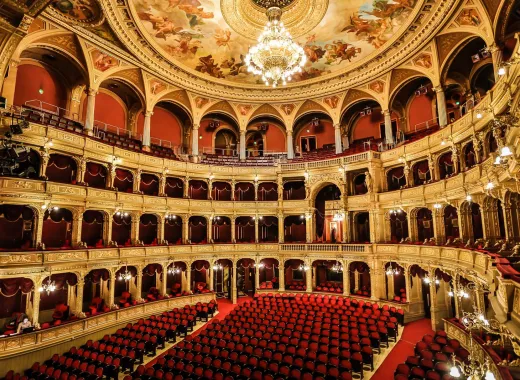



 RM EUROPA TICKET GmbH
 Call now
 Book now