
 EN
EN DE
DE IT
IT FR
FR ES
ES RU
RU JP
JP RO
RO
Bluebeard´s Castle Concert Version
Order tickets
 June 2028 June 2028 | ||||||
|---|---|---|---|---|---|---|
Mo | Tu | We | Th | Fr | Sa | Su |
Bluebeard's Castle – Béla Bartók | Opera IC Audiophile series
Running time: 1 hour 15 minutes without intervals
Language: Hungarian
Surtitle: Hungarian, English
There are evenings when our Opera House cannot perform because rehearsals are ongoing on stage until the evening. There are audience members who can only afford to hear their favourite pieces with a discount. And there are works that, although very popular, cannot be staged every season due to the congestion of productions. All these issues can be solved at once by the Hungarian State Opera’s new IC series, whose name carries the of iron curtain, but which may also gain popularity with the speed of an express train. Even though it will feature in the programme as a regular series beginning only with the next season, we are already presenting this new, semi-staged operatic format that offers more than concert performances on selected evenings during the current one as a preview. The titles are major works by great composers, requiring smaller choruses but offering fewer but particularly significant soloist roles.
A mere hour after a stage rehearsal, visitors having purchased their ticket with a 20% discount find the iron curtain of the Opera House lowered. The massive double steel plate, covering a surface of 170 m², does not only conceal the set of the next production behind it but also serve as an acoustic reflector meeting audiophile standards. Onto this enormous surface, decorated with architect Miklós Ybl’s engravings, we project a unique video installation, with Hungarian and English surtitles displayed at the top. The orchestra takes its usual place in the pit, while the hand-picked, first-rate singers step through the door in the iron curtain to take a seat at the front of the stage, then step into the limelight when it is their turn to sing.
The form is quasi-concert-like, but the soloists do not use sheet music, they appear in period costumes, and can use their faces, hands, and bodies for dramatic gestures. The participating chorus performs from various points of the building to astonish the audience with a powerful 3D sound. From all this, a single, significant, shared experience can emerge: the wonder of sound that feels much closer to the audience, magnifying gestures and offering a far more intense, truly record-quality experience in an auditorium that is thus transformed into one with the best acoustics in Hungary, the concert hall of the Opera House.
In the 2026/27 season, audiophile concert performances of Bluebeard's Castle, Don Giovanni, Rigoletto, and Tosca continue the series started in 2025.
Parental guidance: The performance is not recommended for children under 12 years of age.
Synopsis
The protagonists of Béla Bartók and Béla Balázs’s symbolist opera are Bluebeard and his wife, Judith, who has left her family and her betrothed in order to follow her love. However, Bluebeard’s castle – that is, his soul – contains seven closed doors. Judith persuades her husband to open them, one after the other.
Behind the first door is the torture chamber, while the second leads to the armoury. Still unsatisfied, Judith wants to open the other doors in order to fill her beloved’s castle with light. Bluebeard gives her three more keys: the third is for the treasury, the fourth opens the door to the hidden garden. The treasure and the flowers, nevertheless, are bloody. At her husband’s bidding, Judith also opens the fifth door, where Bluebeard’s realm shines with brilliant light. The clouds, however, cast dark shadows.
Judith now wishes to look behind the “innermost” doors, but she asks Bluebeard in vain: she must not ask, but instead simply love him. Judith receives the sixth key, which opens the door to the lake of tears. From behind the final door emerge the three former wives. All goes dark.
Program and cast
Conductor: Levente Török
Conductor: Zsolt Hamar
Judith: Anna Kissjudit, Andrea Szántó, Zsuzsanna Ádám
Bluebeard: Krisztián Cser, Christopher Maltman, András Palerdi
Featuring the Hungarian State Opera Orchestra
English translation by Arthur Roger Crane
Composer: Béla Bartók
Librettist: Béla Balázs
Hungarian State Opera
STANDING ROOM TICKETS - INFORMATION IN CASE OF A FULL HOUSE!
If all the seats are sold out for the selected time, but you still want to see the production on that day, 84 of the extremely affordable standing seats will be sold at the theatre, 2 hours before the start of the performance, with which you can visit the gallery on the 3rd floor. Tickets can be purchased at the ticket office of the Budapest Opera House. We would like to draw your attention to the fact that the stage can only be seen to a limited extent from the standing places and the side seats, but at the same time, following the performance is also supported by television broadcasting on the spot.
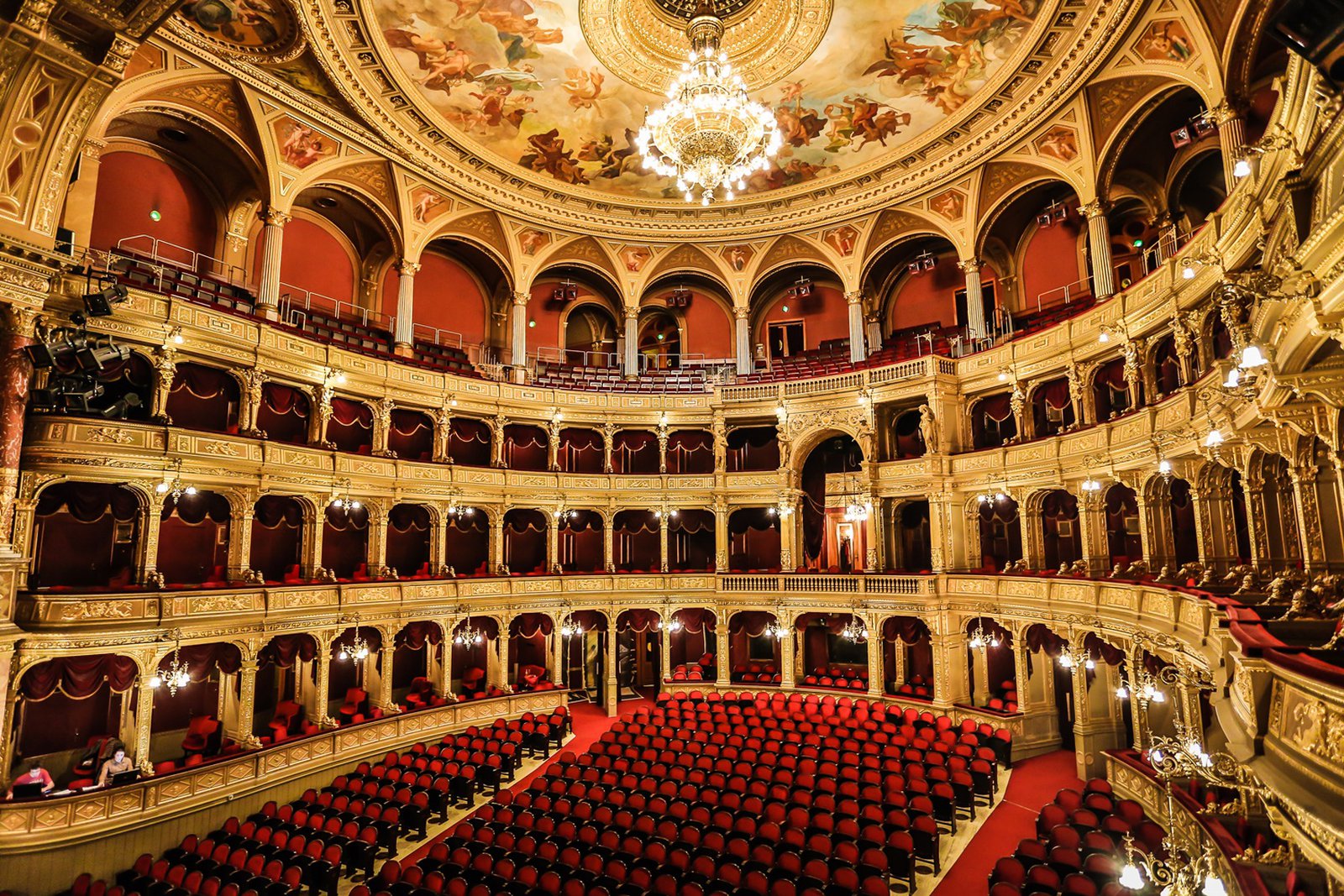
The Opera House is not only one of the most significant art relic of Budapest, but the symbol of the Hungarian operatic tradition of more than three hundred years as well. The long-awaited moment in Hungarian opera life arrived on September 27, 1884, when, in the presence of Franz Joseph I. the Opera House was opened amid great pomp and ceremony. The event, however, erupted into a small scandal - the curious crowd broke into the entrance hall and overran the security guards in order to catch a glimpse of the splendid Palace on Sugar út. Designed by Mikós Ybl, a major figure of 19th century Hungarian architecture, the construction lived up to the highest expectations. Ornamentation included paintings and sculptures by leading figures of Hungarian art of the time: Károly Lotz, Bertalan Székely, Mór Than and Alajos Stróbl. The great bronze chandelier from Mainz and the stage machinery moda by the Asphaleia company of Vienna were both considered as cutting-edge technology at that time.
Many important artists were guests here including Gustav Mahler, the composer who was director in Budapest from 1887 to 1891. He founded the international prestige of the institution, performing Wagner operas as well as Magcagni’ Cavalleria Rusticana. The Hungarian State Opera has always maintained high professional standards, inviting international stars like Renée Fleming, Cecilia Bartoli, Monserrat Caballé, Placido Domingo, Luciano Pavarotti, José Cura, Thomas Hampson and Juan Diego Flórez to perform on its stage. The Hungarian cast include outstanding and renowed artists like Éva Marton, Ilona Tokody, Andrea Rost, Dénes Gulyás, Attila Fekete and Gábor Bretz.
©

Related events