
 EN
EN DE
DE IT
IT FR
FR ES
ES RU
RU JP
JP RO
RO
Best of Händel, Dido and Aeneas
Order tickets
 November 2027 November 2027 | ||||||
|---|---|---|---|---|---|---|
Mo | Tu | We | Th | Fr | Sa | Su |
Best of Händel / Dido & Aeneas – George Frideric Handel / Henry Purcell
Contemporary | Opera
Language: English
Surtitle: Hungarian, English
Running time: 2 hours 30 minutes including one interval
Best of Händel: 50 minutes
Interval: 30 minutes
Dido & Aeneas – Act I: 20 minutes
Dido & Aeneas – Act II: 20 minutes
Dido & Aeneas – Act III: 20 minutes
Henry Purcell’s epic masterpiece, Dido and Aeneas has to do with the Trojan War. But what is even more important than the historical background of this hour-long little gem is love – as Dóra Barta, the director of the production highlights it, “Humanity has long known that if there is something you can die of, Love is certainly such a thing. Whether it is happy or not, returned or unrequited, one thing is sure: it is dead serious business. The tragic-ending romantic affair enfolding between the queen of Carthage and the Trojan hero was made into a grand classic of universal cultural history by Virgil, but it was the thirty-year-old Henry Purcell whose music made its heroes rise to the stars, among which they have been shining with never fading light for three and a half centuries now.”
The compositions of Georg Friedrich Händel, who spent most of his life in England and whose works, aside from Messiah, are rarely performed at the Opera House, create an authentic Baroque atmosphere ahead the tragic love story of the Trojan prince and the of Carthage, the most significant work by an outstanding figure of English early music, Henry Purcell.
Parental guidance: The performance is not recommended for children under 12 years of age.
Synopsis
Act I
Under the rule of Dido, the queen of Carthage, who is in possession of great creative power, the city grows and prospers. Nevertheless, she has been consumed by melancholy for some time, and she is unsure if she can find peace ever again. What could be wrong? After all, the empire has never been so fortunate. Belinda, the queen's lady-in-waiting, suspects the reason: Dido has fallen in love with Aeneas, the Trojan warrior enjoying their hospitality after fleeing to Carthage following the fall of Troy. Perhaps even Dido fears of admitting the truth to herself, being afraid of loss and pain, being afraid of weakening as a leader if she succumbs to her emotions. However, the ladies of the court encourage her: it would be beneficial politically if Troy and Carthage were united. Moreover, Aeneas also seems to be in love with Dido. When the hero appears, Dido first gives him the cold shoulder, but later she cannot control her emotions and surrenders herself to love, while a never-ending doubt starts a certain internal destruction in her soul.
Act II
Scene 1
Happiness is never easy: dark shadows appear, the Sorceress can no longer bear to look upon the success of the empire and Dido's happiness. Therefore, she decides to put an end to both. He calls her witches for help and shares her plan with them: the evil spirit appearing in the image of Mercury, the messenger of the gods will let Aeneas know that he must set out immediately. This will cause Dido to despair and die of her pain, and Carthage will be consumed by flames. The witches improve the excellent plan with another idea: they will conjure up a storm around the lovers while they are hunting, thus separating them in order to carry out the evil deed.
Scene 2
Dido and Aeneas happily indulge in the pleasures of hunting, but Dido hears the thunder, which puts an end to their fun. They return to the palace, but Aeneas is halted by Mercury, i.e. the evil spirit of the Sorceress, who tells him that he must set out tonight to establish the new Troy in Italy. Aeneas has no other choice than to obey the divine command, but he has no idea yet how to tell his lover...
Act III
Scene 1
The sailors bid farewell to their casual lovers and prepare for the long voyage. The Sorceress and her witches are satisfied, their plan is going well. The Sorceress comes up with another idea: she will make Aeneas die in the sea during a storm to complete the guile.
Scene 2
In her palace, Dido feels that her initial fear was well-founded. The thing she was afraid of, the reason she did not want to succumb to love has come to pass. Even Belinda cannot comfort her. Aeneas comes to say goodbye, but Dido has already given up on this relationship. Seeing her desperation, Aeneas would stay refusing the divine (or what he believed to be divine) command, but Dido is adamant. She no longer wants to continue this relationship. After Aeneas leaves, the once strong queen weakens, collapses, there is nothing left for her but death, since nothing will harm her in her grave, she will not have to face similar torments to what this love brought her. The rest say goodbye to her hoping that the god of love himself will watch over her grave.
Program and cast
Conductor: Augustin Szokos
Conductor: Dániel Erdélyi
Dido: Kinga Kriszta
Aeneas: Zsolt Haja
Belinda: Ildikó Megyimórecz
Sorceress: Andrea Szántó
First Enchantress: Mária Farkasréti
Second Enchantress: Diána Ivett Kiss
Sailor: Artúr Szeleczki
Spirit: N. N.
Handmaid: N. N.
Featuring the Hungarian State Opera Orchestra and Chorus
Director and Coreographer: Dóra Barta
Set designer: Ildi Tihanyi
Costume designer: Andrea Kovács
Lighting designer: Zoltán Katonka
Dramaturg and Hungarian translation by: András Almási-Tóth
Musical director: László Bartal
Chorus director: Gábor Csiki
Composer: Henry Purcell
Librettist: Nahum Tate
Musical intermezzi: Bence Farkas
Hungarian State Opera
STANDING ROOM TICKETS - INFORMATION IN CASE OF A FULL HOUSE!
If all the seats are sold out for the selected time, but you still want to see the production on that day, 84 of the extremely affordable standing seats will be sold at the theatre, 2 hours before the start of the performance, with which you can visit the gallery on the 3rd floor. Tickets can be purchased at the ticket office of the Budapest Opera House. We would like to draw your attention to the fact that the stage can only be seen to a limited extent from the standing places and the side seats, but at the same time, following the performance is also supported by television broadcasting on the spot.
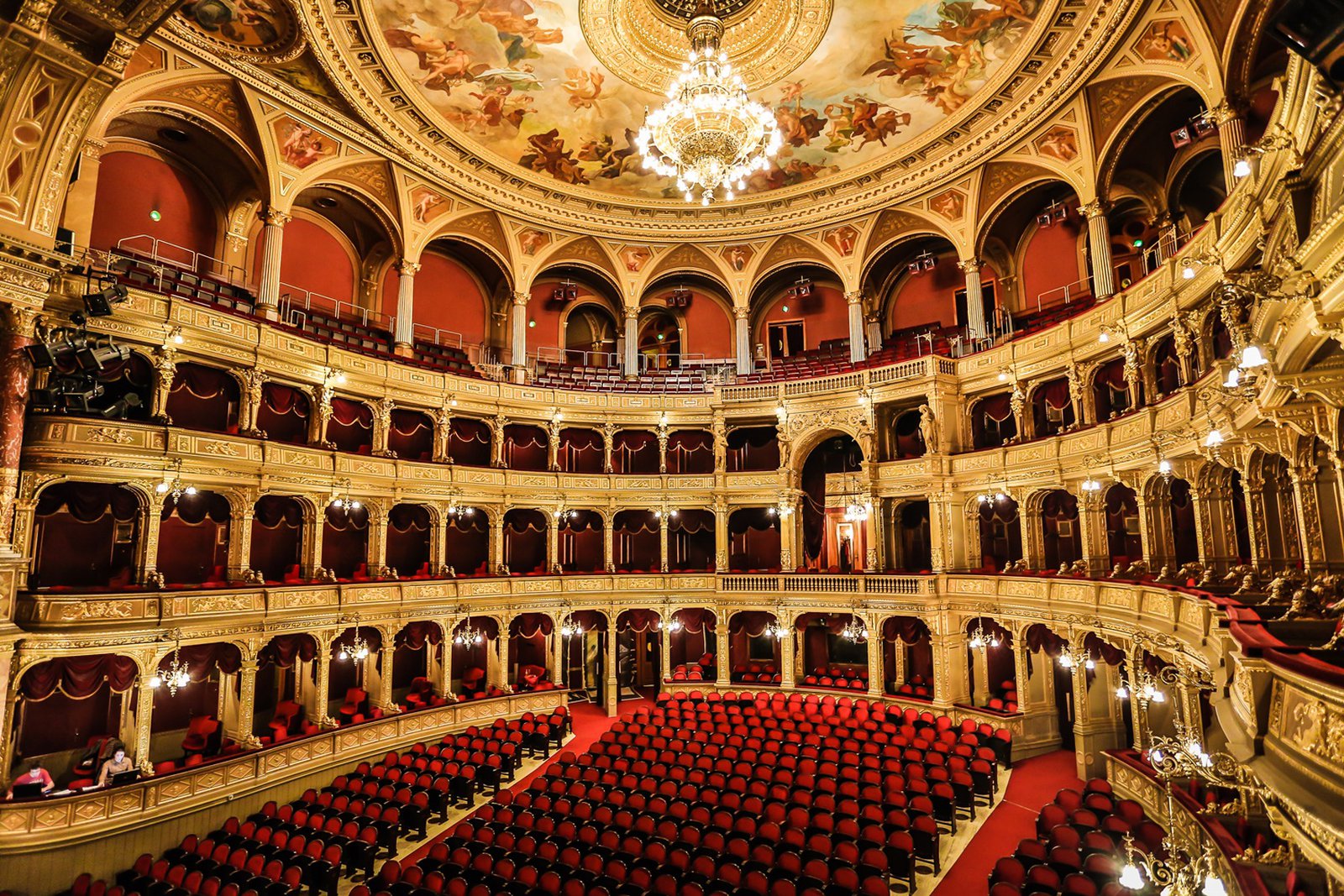
The Opera House is not only one of the most significant art relic of Budapest, but the symbol of the Hungarian operatic tradition of more than three hundred years as well. The long-awaited moment in Hungarian opera life arrived on September 27, 1884, when, in the presence of Franz Joseph I. the Opera House was opened amid great pomp and ceremony. The event, however, erupted into a small scandal - the curious crowd broke into the entrance hall and overran the security guards in order to catch a glimpse of the splendid Palace on Sugar út. Designed by Mikós Ybl, a major figure of 19th century Hungarian architecture, the construction lived up to the highest expectations. Ornamentation included paintings and sculptures by leading figures of Hungarian art of the time: Károly Lotz, Bertalan Székely, Mór Than and Alajos Stróbl. The great bronze chandelier from Mainz and the stage machinery moda by the Asphaleia company of Vienna were both considered as cutting-edge technology at that time.
Many important artists were guests here including Gustav Mahler, the composer who was director in Budapest from 1887 to 1891. He founded the international prestige of the institution, performing Wagner operas as well as Magcagni’ Cavalleria Rusticana. The Hungarian State Opera has always maintained high professional standards, inviting international stars like Renée Fleming, Cecilia Bartoli, Monserrat Caballé, Placido Domingo, Luciano Pavarotti, José Cura, Thomas Hampson and Juan Diego Flórez to perform on its stage. The Hungarian cast include outstanding and renowed artists like Éva Marton, Ilona Tokody, Andrea Rost, Dénes Gulyás, Attila Fekete and Gábor Bretz.
©

Related events